Diagnostic app for piloted alternators, paired with MultiMEC hardware
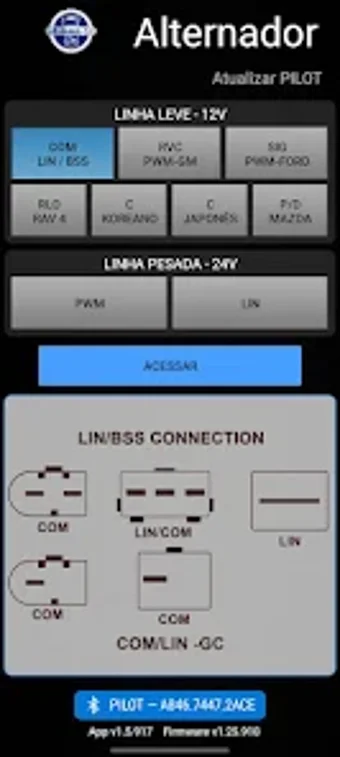
MultiMEC PILOT - Alternador by MultiMEC is a professional Android app for testing modern piloted alternators. It connects to the MultiMEC PILOT hardware and serves as a visual interface that simulates ECU signals, monitors voltage regulators in real time, and produces diagnostic reports to isolate alternator, wiring, or central-unit faults. Key capabilities include protocol support (LIN, BSS), bench and in-vehicle testing modes, and report sharing. Intended users are auto-electricians and workshop technicians who need alternator-specific diagnostics and traceable test records.
What is the app used for in workshop diagnostics?
The app serves as a dedicated visual interface for technicians to test modern piloted alternators. Using the hardware connection, the app can simulate ECU communication and present live traces of voltage and regulator signals. These functions let a technician distinguish whether charging faults originate in the alternator, vehicle wiring, or the central control unit, enabling focused troubleshooting during both on-vehicle checks and bench evaluations.
How precise is its alternator signal monitoring?
The app provides real-time monitoring of alternator voltage and signal patterns, and supports modern piloted protocols such as LIN and BSS. Live traces display regulator behaviour and timing, which technicians use to interpret control commands and voltage response. The app supports testing across 12V and 24V systems, so measurement sessions reflect the vehicle electrical architecture encountered in light and heavy-duty workshop environments.
Does the app work without MultiMEC PILOT hardware?
No. The app operates as a front-end for the MultiMEC PILOT diagnostic device and requires a Bluetooth Low Energy link to perform tests. It runs only on Android devices with BLE support and does not execute diagnostic sequences locally without the hardware. For protocol coverage the app lists several alternator types, including COM (LIN and BSS), SIG (PWM-FORD), RVC (PWM-GM), and P/D (MAZDA).
Who benefits most and what are practical constraints?
The app targets automotive professionals: auto-electricians, mechanics, and workshop technicians who maintain piloted charging systems. Its bench and in-vehicle modes suit shops that perform component-level alternator servicing and need sharable diagnostic reports for records. Practical constraints include the tool's narrow focus on alternator diagnosis and the operator skill required to interpret signal traces; technicians must pair electrical readings with manufacturer repair procedures to avoid misdiagnosis.
Practical specialist choice for workshops with trained technicians
PILOT is a targeted choice for workshops that need focused alternator diagnostics and structured test records. Adoption makes sense for teams prepared to train technicians on electrical-trace interpretation and to integrate test outputs into repair workflows. Given its narrow scope, teams should use it as a specialist complement to broader diagnostic suites rather than as a single-tool replacement. Plan periodic calibration checks to maintain consistency.